Student Evaluations
Check out my student evaluation summary for the work I have done at the University of Arkansas! I am working on creating a similar document for the classes I taught at Mississippi University for Women, the University of Texas-Permian Basin and the University of Central Arkansas, as time allows.
My overall median rating for AY 2017-2023: 4.75 out of 5.0 scale
Department of English median instructor rating for AY 2017-2023: 4.50 out of 5.0 scale
“Ms. Figgins has been an amazing instructor. She brought in new ways for us to learn and get hands on experience with some of the harder topics. She was very empathetic and truly focused on helping each student succeed. Genuinely the best instructor I’ve had in my college career.”
Composition 2: Mutations, Monsters, and Media, Spring 2021 student evaluation
Innovative Teaching Practices
Interactive Work
About learning, Lev Vygotsky said “what [one] can do in cooperation today she can do alone tomorrow.” I believe that we learn better together and can come to a fuller understanding of literature when we build on one another’s learning, background, and experiences. Discussion is certainly a huge component of any course I teach, but I also try to find ways of learning that are more hands-on and explicitly interactive.
Example 1: Mary Seacole Press Conference
Example 2: Gothic Speed Dating
Example 3: Podcast Project
“Overall this was probably my favorite class. Professor Figgins creates lots of time for her students to come in and meet with her during office hours and responds to emails very quickly when you need help. She was very clear throughout the whole course and made sure to repeat what you needed to do in order to get different grades in the class (the ‘A’ and ‘B’ grade requirements), which helped a lot. She also makes sure we fully understand the readings after we read them. Love her and love this class!”
World Literature, Fall 2020 student evaluation
Grading Contracts & Self-Assessment
In Spring of 2020, I started experimenting with grading contracts and found it to be a very accessible and equitable way of approaching grading, especially for the writing classroom. A version of my grading contract was recently adapted for use by all of the Composition 1 and Composition 2 courses at the University of Arkansas.
In 2024, I began to move away from contract grading based on the research critiquing labor-based contract grading. While I still feel that contract grading can be tailored to be fair and equitable, I also began playing around with other forms of nontraditional grading, such as self-assessment. I found that, when scaffolded appropriately, self-assessment can be a good way of helping students to understand the entire learning process more deeply.
Advanced Composition, Spring 2023 student evaluation
“Dr. Figgins has been a great joy to have for this class. She is constantly being inclusive, caring, thoughtful, and supportive. The assignments for this course have made me a better writer, and I feel more prepared to enter the workforce. She is a great instructor!!”
Slack for Teaching
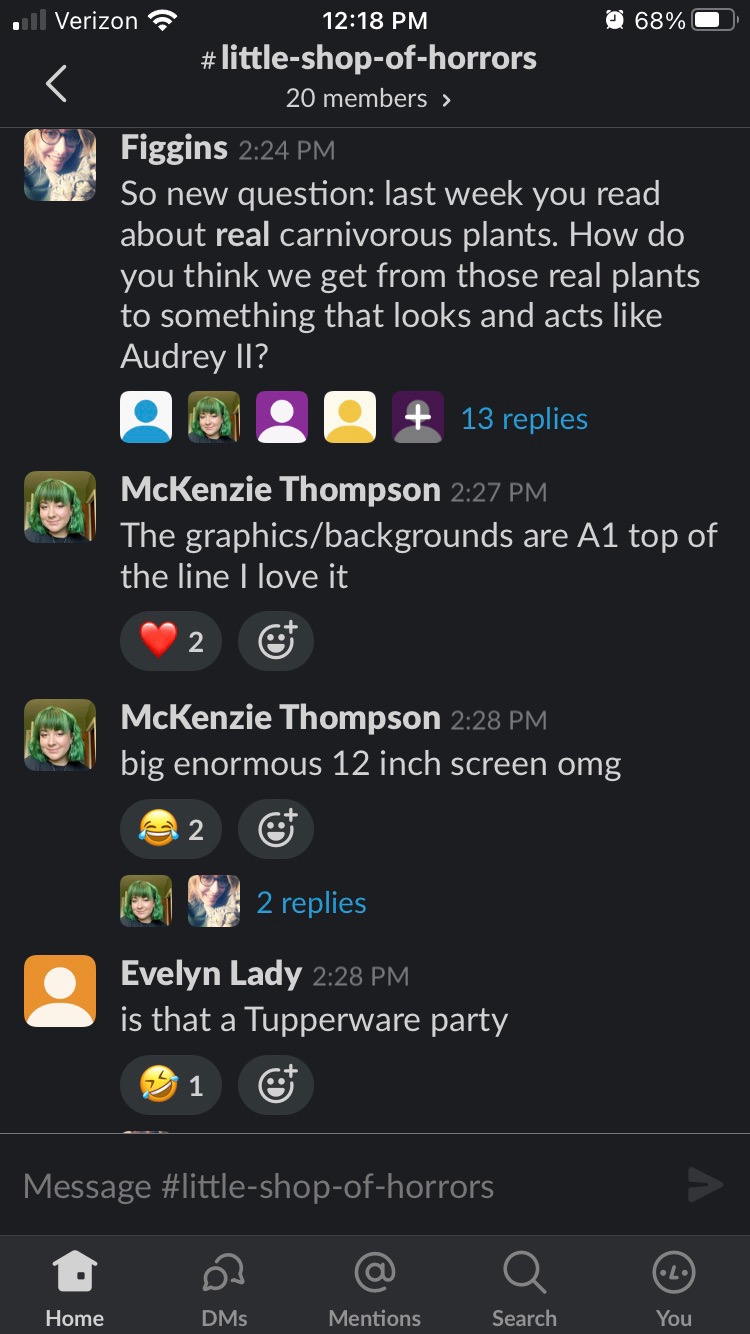
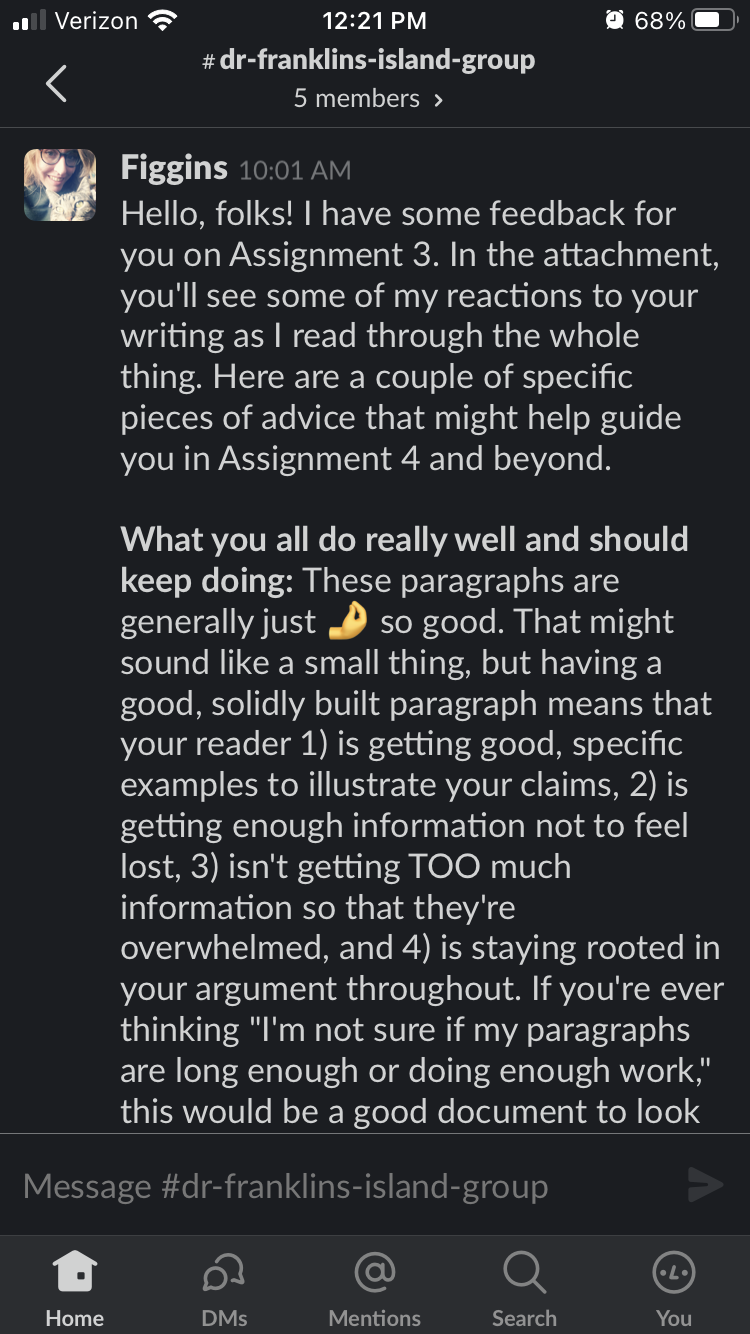
In 2021, I started using Slack for teaching and am embarrassed to say that I kind of fell in love. And so did my students! The platform is really intuitive for doing things like film screenings, which I wrote about here, and it’s also a great way to get announcements out to students who aren’t always checking their emails, house important information about upcoming assignments, and even give feedback (especially to groups).
While I think Learning Management Systems are great (and I’ve used them all from Moodle to Canvas to Blackboard), it’s important to find multiple entry points for students to get course information, especially since LMS systems aren’t super intuitive. Slack fills a huge gap for that, especially in regard to remote/online teaching.


Visual Syllabus
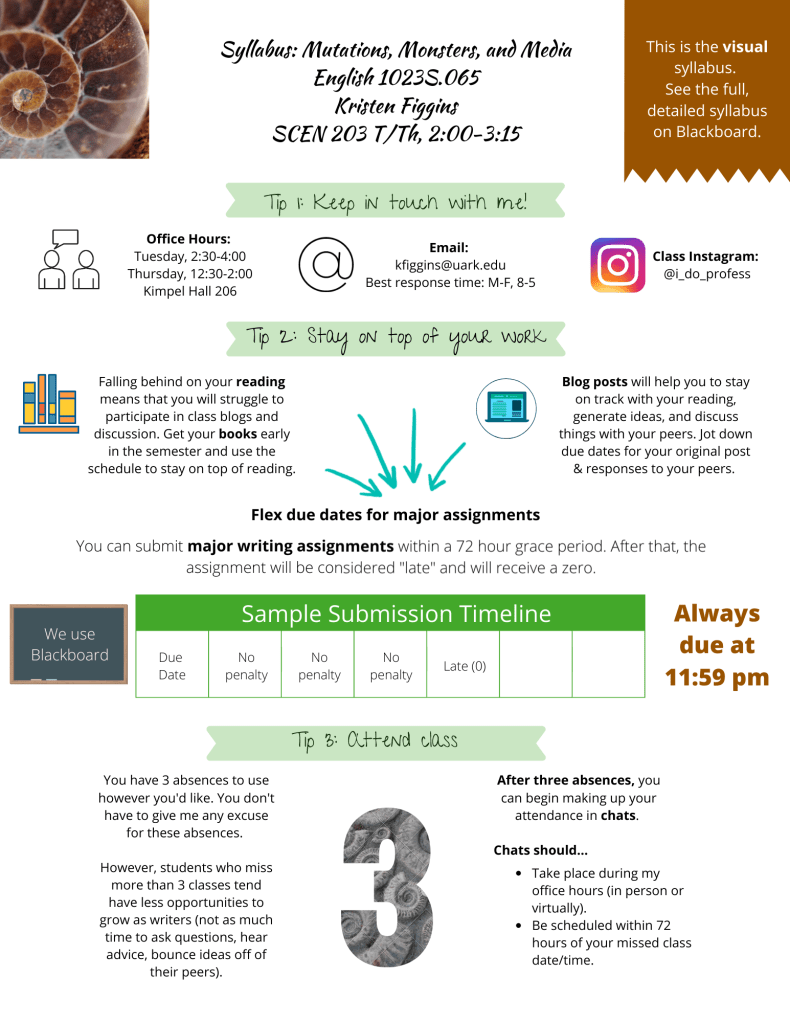
As syllabi get more complicated, students report feeling overwhelmed by the amount of resources available to them. As a supplement to my lengthier syllabus, grading contracts, and course schedules, I also provide students with a “visual syllabus” on the first day of class, which they supplement with the lengthier versions at home. They come to class prepared to discuss their ideas and questions about the longer documents because they know what to expect.
This version of the syllabus also allows me to link to important resources on campus.

 Kristen Figgins, Ph.D.